
California Employer Resource · FTE Calculation
🧮 Do Part-Time Employees Count Toward the 50-Employee Limit?
The IRS doesn’t just look at full-time titles — it measures total hours worked across your entire team.
📖
Looking for the full employer rulebook — the mandate, penalties, and tax credits? See the full guide →
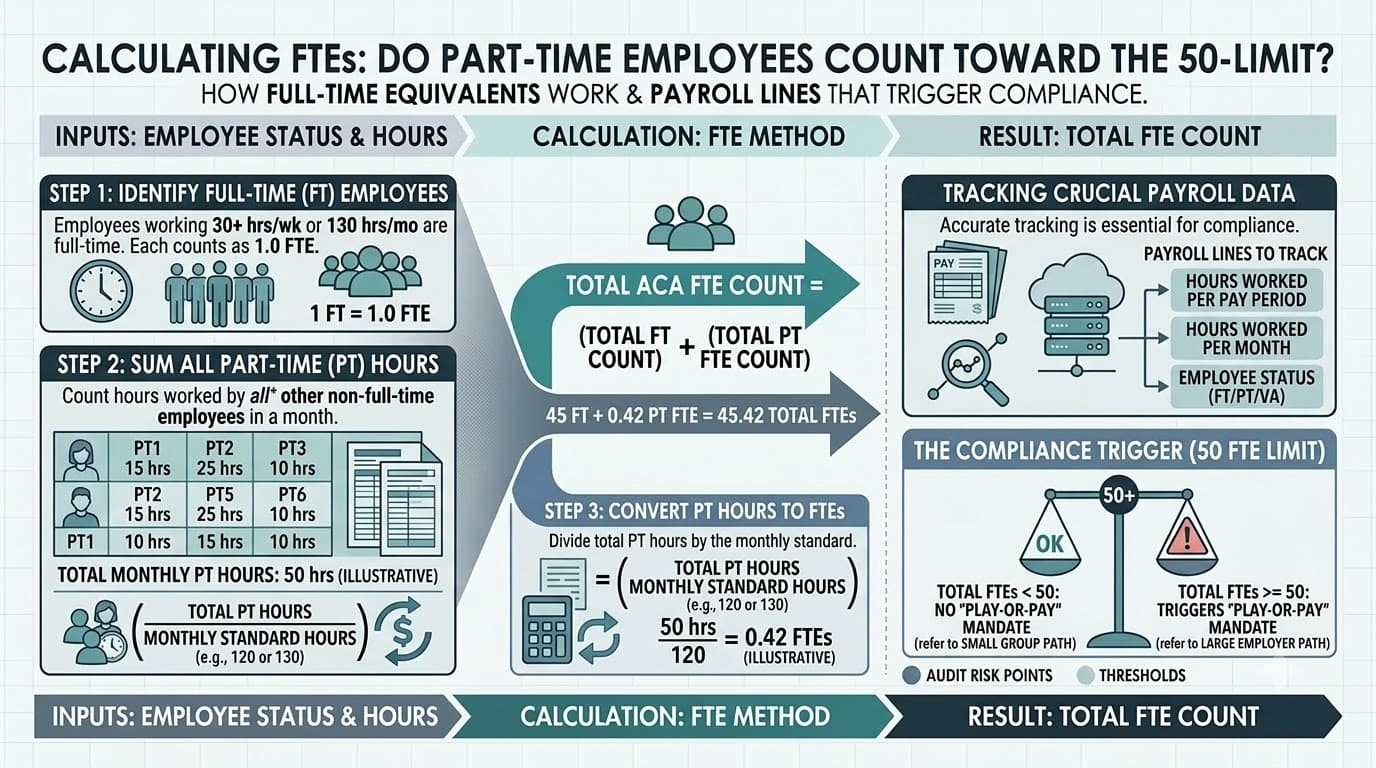
📐 How do I calculate my actual FTE count?FTE Math
- Full-Time Staff: Anyone averaging 30+ hours/week (or 130 hours/month) counts as 1 full-time employee.
- Part-Time Staff: The hours of all workers under 30 hours/week are added together each month and divided by 120.
- The Combined Total: Your full-time count plus your part-time equivalent calculation gives your official FTE total.
Part-Time Total Hours: 24 × 80 = 1,920 hours/month
Equivalent FTE Count: 1,920 ÷ 120 = 16 FTEs
Total Compliance Roster: 35 Full-Time + 16 FTEs = 51 Total FTEs
Even though this business only has 35 full-time workers, the combined part-time hours push them over the 50-FTE line — making them subject to federal compliance mandates.
Equivalent FTE Count: 1,920 ÷ 120 = 16 FTEs
Total Compliance Roster: 35 Full-Time + 16 FTEs = 51 Total FTEs
⚖️ Stay Ahead of Compliance
👨⚕️ “ACA, Cal-COBRA, ERISA. The rules change. You stay ahead.”
👩⚕️ “Vetted TPA and compliance partners, plus expert-reviewed HR and legal resources, keep you informed all year. Who on your team tracks those mandates today?”
🛡️ Talk Compliance Support: Know Where Your Plan Stands📬 What happens if I get this wrong?Risk
- Retroactive Audits: IRS notification letters (such as Letter 226J) often arrive 12 to 24 months after the tax year ends. If part-time hours put you over 50 FTEs during that year, penalties accumulate silently month by month.
- Sudden Benefit Demands: If a part-time employee’s hours fluctuate over 30 hours/week during a measurement period, failing to track those hours can create immediate liability or trigger exchange subsidy notices.
- Operational Friction: Trying to artificially cap worker hours to stay under thresholds can damage employee trust, increase turnover, and disrupt daily production.